Tag Archives: Pierre Gervois

“The new generation of affluent Chinese tourists in the U.S.”: Exclusive interview with Pierre Gervois

Pierre Gervois exclusive interviewWe had the pleasure to have an interview with Mr Pierre Gervois, CEO of the publishing company China Elite Focus and Publisher of the Chinese luxury travel magazines “Luxury Hotels of America” and “Niuyue Mag”. Mr Gervois, the leading marketing expert for U.S. hotels and CVB’s has answered to our questions about the art of promoting the United States as a tourist destination in China.

How do Chinese tourists choose their leisure destinations?

PG: They massively (more than 80%) search and find their leisure destinations through the Internet and more precisely, independent travel and tour- ism related websites, social media networks, and blogs. China’s most popular online travel agencies and booking engines, such as the very well made ctrip.com, are used for the technical part of the airline ticket purchasing and hotel booking, but beyond that, the choice of destination and hotel is made on influential, independent, travel and tourism websites and blogs. Word-of-mouth has an incredible influence in the choice of a leisure destination, a hotel brand, or the planning of a shopping experience. As most of the young generation of Chinese travellers are first-time travellers (and probably the first persons in their family to experience an overseas leisure trip since their parents and grandparents have probably not ever had this chance), they have no personal or familial emotional connection with foreign destinations, hotel brands, or cultural or entertainment activities. They need to learn from what other people say and write to forge their opinions before they gradually acquire the personal experience of a world traveller.
Why choose to go first to New York or Los Angeles? Why choose shopping sessions at Saks Fifth Avenue or at South Coast Plaza? Why choose to spend a day at Universal Studios Hollywood? The answers to these questions can be found on an incredibly active network of hundreds of independent travel blogs, mostly hosted on China’s most popular social media networks such as Weibo (a very successful mix of Twitter and Facebook) or blogging platforms such as Dian Dian and Douban (very similar to tumblr.com). Endorsement by one or several of these independent travel blogs is worth more than the thousands spent on advertising banners in big, official, online travel agencies. In a digital media environment saturated by direct advertisement—specifically in travel and tourism—genuine and independent endorsement by key opinion leaders is critical.

Advertisement Tower - Gervois Hotel Rating May 2017 featuring Pierre GervoisHow can U.S. industries work with the network of Chinese outbound travel agencies?

PG: One of the biggest issues that U.S. hotels and destination management companies have to deal with is the relative weakness of the network of official, state-owned, Chinese outbound travel agencies in terms of their ability to advise their clients in choosing a specific leisure destination. One of the main reasons is the lack of training and expertise of Chinese travel agents who have very little experience in international travel themselves, and therefore, the lack of confidence of the new generation of Chinese travellers in the ability of their local travel agents to advise them in choosing a destination or a specific kind of hotel overseas. Things are slowly changing as the National Tour Association (NTA) has developed programs to invite Chinese travel agents to participate in familiarization tours to the U.S., but these initiatives remain isolated and can influence only a fraction of all Chinese travel agents. It’s important to consider that the highly professional net- work of U.S. inbound travel agencies have very few counterparts in China with the same levels of professionalism and expertise.

From a U.S. perspective, what are the differences between Western Europe inbound tourists and Chinese inbound tourists?

PG: There is a world of difference: European inbound travellers have been exposed to U.S. brands for decades, and associate them with values such as freedom, independence, lifestyle, and quality. Most European tourists have in their subconscious minds the stories of their fathers or grand- fathers about the GI’s coming to liberate Europe, bringing with them new products and new values; they may also recall the American movies they watched during their childhoods. When visiting the U.S., they have a deep emotional connection with the country.
For Chinese tourists, this emotional connection is non-existent; fifteen years ago, the concept of a leisure trip to the western world was unthinkable. Moreover, until recently very few American products were available in China, and American movies were not available in Chinese cinemas. The U.S. travel and tourism industry must understand that very specific marketing and promotion campaigns are needed to attract Chinese tourists; these require very different strategies from what has been done in the past with Western European markets. The new generation of Chinese tourists sees the U.S. differently than a British or an Italian tourist would see it, and it must be translated into the marketing campaigns undertaken by hotels, retailers, or entertainment parks targeting Chinese visitors.
3 Comments

Filed under USA

Founder of One of the Top Travel PR Firms Named Editor-At-Large for Luxury Hotels of America magazine

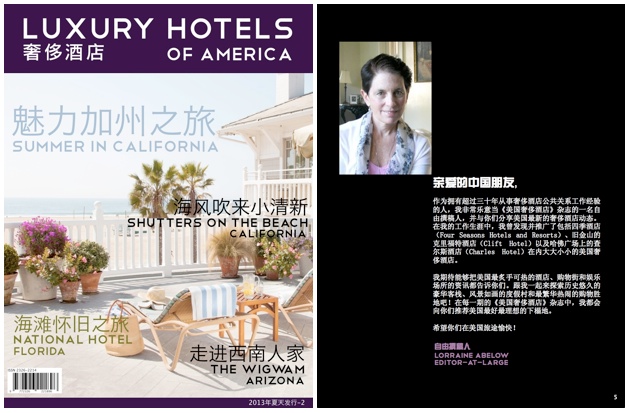
Luxury Hotels of America - Lorraine AbelowAs the head of one of the country’s top travel PR firms, I am constantly tracking continuing and emerging trends influencing the hotel and travel industries. I am pleased to announce that following a recent meeting in New York City with Pierre Gervois, CEO of China Elite Focus, I will be joining his team as the new Editor-at-Large of the prestigious magazine, Luxury Hotels of America.

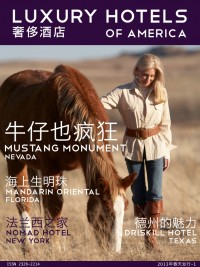
Read by over 40,000 affluent and independent Chinese travelers, Luxury Hotels of America is a quarterly iPad only publication published entirely in Chinese language and focused exclusively on travel to the United States. It is the go-to source of information for the new generation of affluent Chinese outbound tourists planning a leisure and shopping trip to the United States.

In each issue, I will be discussing a recent trend in America’s most historic and unique boutique hotels. Our hotel PR firm understands the importance of properties appealing to the growing Chinese affluent class and their specific travel interests and needs. I look forward to bringing news on the hottest places to stay, shop and play in the US to this growing audience of Chinese tourists.

Bringing My Experience Running a Hotel PR Firm to a New Audience

From the most tech-savvy guest experiences to over-the-top shopping concierges and private jet transport, I will uncover the best travel secrets to appeal to the Chinese desire for over-the-top, luxury accommodations and shopping experiences.

With over 30-years of experience leading a top travel public relations agency, I am often approached by publications seeking insight into how the most exclusive hotels around the world are adapting to draw the interest of different markets. I am particularly thrilled to be working with a publication that is entirely focused on such a substantial and meaningful share of today’s travelers, the Chinese. In fact, the number of Chinese tourists visiting America each year only continues to grow at exponential rates.

At our PR agency, we work with our clients to find creative ways to attract and meet the demands of travelers from different backgrounds. I want to thank Pierre Gervois for giving me this opportunity to share my knowledge and in turn grow through direct interaction with Chinese tourists!

I am excited to share my travel industry expertise in encouraging the Chinese to explore the United States’ best historic inns, unique hotels, lush resorts and jet-set shopping destinations.

Lorraine Abelow

CEO, Abelow PR

Reproduced with permission from www.abelowpr.com

Leave a comment

Filed under Uncategorized

China’s new national tourism strategy set to increase outbound tourism: a chance for the U.S.

Luxury Hotels of America Winter 2013 CoverThe Chinese government has announced a series of initiatives aimed at increasing travel among its citizens. In a recently released document, the government emphasized the importance of travel as an avenue to enhance both the nation’s economy as well as individuals’ quality of life.

“Outlines of the Chinese Citizens’ Travel Initiatives 2013–2020,” released only in Chinese, details plans for improving China’s travel and tourism infrastructure and offering incentives to travel. Among the specific steps the government will take are:

building or expanding airports, highways, hotels and attractions.
increasing the amount of paid leave for workers.
increasing tax deductions for company incentive and conference travel.
allowing schools to expand current travel windows beyond summer and winter breaks.

Through October of last year, the number of Chinese visitors to the United States was up 37 percent from 2011. In light of this surge, the prospect of more Chinese travelers is compelling for tourism professionals.

“This news has extraordinary implications for the North American travel industry,” said Lisa Simon, president of NTA. “China’s U.S. arrivals have increased dramatically since 2008, so the projection of even more visitors confirms what NTA has been saying to its members: Take steps now to capitalize on this wave of tourists.”

The Chinese government is making travel a clear priority, said Haybina Hao, NTA’s director of international development. “Chinese leaders recognize that travel expands the horizons of its citizens, and when people see more of the world, they can return to China inspired and better prepared to be creative entrepreneurs,” Hao said.

Advertisement Tower - Gervois Hotel Rating May 2017 featuring Pierre Gervois“The NTA has done a remarkable work with Chinese travel agents to help them to better understand the U.S. destinations.” said Pierre Gervois, CEO of China Elite Focus, who publishes magazines in Chinese language for affluent Chinese travelers to the United States such as Luxury Hotels of America or VIP Golf USA.  Pierre Gervois added “Don’t forget that the most affluent segment of Chinese travelers to the U.S. don’t rely on their travel agents to build their leisure trip to the U.S., but more on influential luxury travel publications and recommendations of VIP travel clubs. It’s important for U.S. destinations and hotels to talk directly to their future Chinese guests through these selected channels”

The plan calls for a 10 percent increase in domestic and international travel during 2013. It also emphasizes sustainable tourism.

Hao predicts an upsurge in many types of outbound travelers to the United States. “We’ll see student groups coming not just for summer camps or winter holidays but during the regular school year,” she said. “We’ll also see more travelers coming to attend business conventions and study tours, as well as more families and seniors groups.”

NTA has been heavily involved in the China outbound market since 2008, when the governments of the United States and China signed a memorandum of understanding allowing Chinese leisure travelers to visit the United States in group tours. NTA launched its China Inbound Program that year and has since maintained a list of U.S. tour operators registered to handle inbound Chinese group travelers. And next month, Hao will be in Beijing for the China Outbound Travel & Tourism Market, where NTA is partnering with Brand USA to present the USA Pavilion.

China’s latest plan to further increase travel is a call to action, said Hao. “These initiatives will change China and will reshape our industry if we can grab the opportunity,” she said. “Chinese travel agencies are working now to identify more products and American partners, so this is a perfect time to attend COTTM to present the Chinese trade what the U.S. has to offer.”

This summer, NTA will conduct the second China Market Forum during Contact, the association’s tour operator event, which will be held on Hawai‘i, the Big Island, Aug. 15–17. NTA and Hao also provide customized workshops and strategy sessions for destination marketing organizations and tourism professionals interested in exploring the Chinese market.

Leave a comment

Filed under Uncategorized, USA

Pierre Gervois, the leading expert on marketing to Chinese inbound tourists in the U.S. will be in New York on Oct 18, 2012 for meetings with travel and tourism industry professionals.

Leave a comment

October 3, 2012 · 10:09 am

Niuyue Cap on the head, Shanghai Travelers’ Club “Platinum” Card in hand, Wealthy Chinese tourists arrive in New York City

At the 5th avenue Cartier Flagship store, a Chinese customer in Gucci flip flops, Abercrombie & Fitch T-shirt and a Niuyue Mag Cap on his head is buying three gold “Tank” watches incrusted with diamonds “One for me, one for my wife, and one for my daughter, who is studying in Chicago”, he says with a big smile. “I’m also platinum member of the Shanghai Travelers’ Club”, he added ,“that gives me a VIP welcome in most of luxury stores here”.
Cultural training is imperative for New York-based luxury flagship store employees to build trust among affluent Chinese tourists and creating a custom experience for this group of travelers will help marketers gain brand loyalists, experts say.
Many luxury brands are focusing marketing efforts to Chinese consumers back at home, but with a rising wave of Chinese tourists coming to New York, it is important that brands cater to this group. Luxury marketers need to be more proactive to reach Chinese travelers by training employees and partnering with high-end travel services.
“New York flagships should be more aggressive in inviting and giving a fabulous experience to Chinese tourists,” said Milton Pedraza, CEO of the Luxury Institute, New York. “The city seems to be behind in attracting and nurturing Chinese consumers.
“New York has been slow to appeal to Chinese tourists, even though there is such as large Chinese population in the city,” he said.
“Retailers need to create personal, emotional connections with these consumers by nurturing them and caring for them, which will create a lasting impression.”
In the capital cities of European countries, luxury flagship stores get 50 percent of their value from Chinese tourists, per Mr. Pedraza.
Europeans have been smart in the way they care for Chinese tourists, who tend to buy in volume on shopping trips.
Meanwhile, the United States has not been as open to tourists in its efforts and may have suffered, given the economic times.

According to Pierre Gervois, author of “How U.S. Retail, Travel and Hospitality Industries Can Attract Affluent Chinese Tourists”, “The U.S. travel and tourism industry has understood the financial power of the new generation of affluent Chinese inbound tourists, and how it can give a boost to the country’s economy, but needs to improve the way Chinese visitors are welcomed and understand better the intercultural issues of marketing”
In the past, European tourists were key for New York-based retailers, but tourism from Europe is on the decline. Travelers from China are now the largest group of tourists in New York, and Indian tourists are another group to look out for in the next decade.
To get Chinese consumers into New York flagship stores, luxury brands should partner with high-end hotels, tour operators and restaurants to keep the brand top-of-mind, according to Mr. Pedraza.
But the marketing strategy for luxury retailers also starts in China, when affluent Chinese travelers are planning their NYC shopping trip, and use Chinese social media networks such as Niuyue Mag, with 200,000 registered members, giving shopping tips and specific insights to Chinese shoppers.
Also airports, limos and hotel concierges play a major role in influencing affluent Chinese tourists since these are all stops on the journey to New York.

“There is no question that luxury brands should be using print and their Web sites to attract tourists to their New York stores by showing the experience that they can expect,” Mr. Pedraza said.
“The travel industry is also a huge opportunity,” he said. “Luxury brands have to romance travel agents to get on the map within the travel industry.”
“Brands need to do a better job at creating these partnerships with travel-oriented brands.”
Once in-store, affluent Chinese tourists will need to be made comfortable. To do so, New York flagship stores should start by training their staff on the Chinese culture and traditions.
Stores should have, at minimum, Mandarin-speaking employees and may also want to train in other dialects from Asia.
“Employees should be well-educated in relationship building, not just to process tourist transactions, but to develop longtime relationships with the brand,” Mr. Pedraza said.
“There are luxury brand stores in Shanghai, Beijing and Hong Kong, so these tourist transactions are not a one-shot deal,” he said. “They can also be relationship building.”
Luxury retailers should be aware of the Chinese holiday calendar to understand buying habits during certain holidays and target Chinese consumers for in-store gift buying, per Ken Morris, principal at Boston Retail Partners, Boston.
The holiday calendar may also hint at the time when Chinese tourists are more likely to travel.

Training sales associates on cultural greetings can quickly build trust with incoming tourists and encourage foot traffic.
Stores should also offer in-store shipping options so that Chinese consumers can ship items home. This will eliminate the need to pay sales tax and leave the customer more room in their luggage, per Mr. Morris.
“Not only is the size of the luxury market in China significant, but it continues to grow with a burgeoning middle class aspiring to own luxury brands to demonstrate their wealth,” Mr. Morris said.
“New York is a unique, international city where tourists can readily find bilingual associates,” he said. “By focusing on hiring multilingual staff, a retailer has the opportunity to offer exceptional customer service and make the customer comfortable shopping in the store.”

Source: Chinese Tourists Blog

1 Comment

Filed under New York

In the first half of 2012, +46% of visa applications processed at U.S. Embassy for Chinese leisure travelers

President Barack Obama’s initiative to boost international tourism has pushed the US government to process a record 1 million visa applications from China so far during fiscal 2012.
“This extraordinary accomplishment represents visa processing growth of almost 43 percent over the same period last fiscal year, when we had processed just over 675,000 visa applications in China,” the State Department announced Thursday.
The US federal government’s fiscal year begins Oct 1 and ends Sept 30, so the department was referring to visa-processing totals through the end of the third quarter on June 30. As China Daily reported in April, through the first half of fiscal 2012, the State Department had processed 453,000 visa applications from Chinese citizens, up 46 percent from the first six months of fiscal 2011.
To reach the 1 million figure through the current fiscal year’s first nine months, department staff at the US Embassy in Beijing and the four consulates across China processed at least 547,000 visa applications from Chinese citizens in the three months from April 1 through June 30 – reflecting especially high demand for the busy summer travel season.
The State Department credited the opening of more windows for interviews, expansion of consular office space and better-maintained waiting areas for visa processing at the Beijing embassy and its consulates in Chengdu, Guangzhou, Shanghai and Shenyang. Furthermore, it said the average waiting time for a visa interview has been reduced to about a week from the several months it used to take to get an appointment.
According to Pierre Gervois, CEO of China Elite Focus and the author of the Book How U.S. Retail, Travel and Hospitality Industries Can Attract Affluent Chinese Tourists “This initiative is the direct result of a very successful lobbying campaign organized by the retail, travel, and hospitality industries that were the first-hand witnesses of the incredible purchasing power of Chinese tourists in the last few years. Roger Dow (president of the United States Travel Association) and Joe McInerney (president of the American Hotel & Lodging Association) have done a fantastic job of explaining to Washington the vital necessity to the American economy of finding ways to increase the number of Chinese leisure visitors.”
Dong Xue, a senior at Purdue University in Indiana, has just returned from China and it took her only a week to get a visa, even at the peak of summer. As a repeat traveler to the US, Dong was able to use a bank drop-off service to renew her visa. Without having to go for a personal interview, she submitted her paperwork through the bank and got her visa in five business days.
“As the Chengdu consulate (nearest to her hometown of Chongqing) was very busy then, their colleagues in Guangzhou processed my application,” Dong told China Daily. “It’s so fast. Usually it will take two weeks.”

The Obama administration, pointing out the value of travel and tourism to the US economy, introduced in January a strategy to make the United States the top destination for foreign visitors. More than 1 million jobs could be created over the next decade if the US increases its share of the international travel market, Obama has said.
In 2011, about 1.18 million Chinese visited the United States and the number is expected to reach 2 million in 2015, according to the National Tourism Administration of China.

1 Comment

Filed under Uncategorized

From complimentary Chinese tea to social media marketing, U.S. hotels try hard to entice more Chinese guests

Major hotel brands are bending over backward to cater to the needs of the world’s most sought-after traveler: the Chinese tourist.
Now arriving on American shores in unprecedented numbers thanks to a streamlined visa process and a rising Chinese middle class, Chinese tourists are being treated to the comforts of home when they check in at the front desk. That means tea in rooms, congee for breakfast and Mandarin-speaking hotel employees.
Chinese “welcome programs” at chains like the Marriott and Hilton even address delicate cultural differences: No Chinese tour group should be placed on a floor containing the number four, which sounds like the word for death in Mandarin.
“They’re very relieved, like finally somebody’s doing these things that make sense,” said Robert Armstrong, a sales manager who handles bookings for Chinese travelers at the Waldorf-Astoria in New York.
More than a million Chinese visited the US in 2011, contributing more than US$5.7 billion ($7.2 billion) to the economy. That’s up 36 per cent from 2010, according to the Department of Commerce. By 2016, that figure is expected to reach 2.6 million Chinese.
In a striking departure from the traditional Chinese business traveler, a growing number of them are coming to America for fun – with lots of cash. (The average Chinese visitor spends more than US$6000 per trip.)
 “Chinese Social Media networks are very important to help Chinese travelers to choose their hotel in the U.S.” said Pierre Gervois, Chief Executive Officer of China Elite Focus, a digital marketing agency based in Shanghai and Hong Kong. “New social media networks focused about travel in the United States have emerged last year, and are now very popular, such as Luxury Hotels of America (美国奢侈酒店), or Niuyue Mag (纽约志), and VIP Golf USA (美国VIP贵宾高尔夫). These social media networks allow Chinese travelers to ask for advice to other Chinese tourists coming back from the U.S., and also to rate hotels, golf courses, and retail stores. They are much more influent than travel agencies.”
And so hotels are competing to win the hearts of the Chinese. That may take the form of slippers and a tea kettle in the room or a Mandarin-speaking employee at the front desk.
“They drink tea. Eastern style, everything cold,” explained Charlie Shao, president of Galaxy Tours, a New York City-based Chinese tour agency. “They don’t walk inside the room with bare feet.”
It’s rare that Shao has to ask hotels for anything anymore. Marriott International, for example, now offers several Chinese breakfasts, depending upon which region of China the traveler hails from: there are salted duck eggs and pickled vegetables for eastern Chinese, for example, and dim sum and sliced pig’s liver for the Advertisement Tower - Gervois Hotel Rating May 2017 featuring Pierre Gervoissoutherners.
Major chains are also training employees to avoid cultural missteps that would offend a Chinese visitor. Superstition is a big one: Red is considered a lucky colour, along with the number eight, which signifies wealth. The colour white, meanwhile, is frowned upon.
Failing to respect the pecking order in a Chinese group is another common blunder.
“We try to make sure nobody’s on a higher floor than their boss,” Armstrong said. “Even if the boss is on a beautiful suite on the eighth floor, if the assistant is in a standard room on the 38th floor, it doesn’t translate.”
The race is also on to build loyalty within China’s borders. Last year, Starwood Hotels, which has a Chinese “specialist” at each American hotel, relocated its senior leadership team to China for a month. The Ritz-Carlton rotates general managers and other hotel staff into its Chinese hotels for three-year stints at a time. And both chains are banking on the success of their customer rewards programs, which have been a big hit in China.
“It’s important for our leaders to understand what’s going on there at a more personal level than just the statistics,” said Clayton Ruebensaal, vice president of marketing for the Ritz. “Everybody’s going after this market because of the sheer volume of luxury customers. At the same time, it’s a very crowded landscape.
”
In response to the surge in Chinese visitors, the State Department decided earlier this year to spend US$22 million on new facilities in several Chinese cities and add about 50 officers to process visa applications. And in February, the US government said Chinese visitors who had obtained an American visa within the last four years did not have to reapply in person but could apply via courier.
As a result, visa interview wait times in China are just under a week.
 But some experts say the US still lags far behind other countries, especially in Europe, when it comes to attracting Chinese tourists. America is woefully ill-prepared to welcome China at an industry-wide level, especially at restaurants and major attractions, said Rich Harrill, director of the Sloan Foundation Travel & Tourism Industry Centre at the University of South Carolina.
“We’re not as ready as we should be,” Harrill said.
“We don’t have the language skills. We have an opportunity to be on the ground floor of something that could be very, very big.”

Leave a comment

Filed under USA

Chinese want to buy more Private Jets in the U.S.

The demand for long-range private jets is increasing in China, as wealthy Chinese individuals are looking for aircrafts able to go directly to New York City or Las Vegas from any airport in China. According to Pierre Gervois, CEO of China Elite Focus, the leading PR agency focused on HNWI Chinese consumers “The new generation of Chinese wealthy individuals considers the acquisition of a private aircraft as the ultimate symbol of success. For instance, we know that very private VIP clubs such as the Shanghai Travelers’ Club have already organized trips to the United States with the specific purpose of buying pre-owned private jets in the U.S.”

As many Chinese private jet future owners consider that buying a pre-owned or a new aircraft in the U.S. is the best way to ensure the best quality and perfect maintenance, there is a major opportunity for the U.S. business jets industry, or foreign aircraft manufacturers operating from the U.S. and targeting new Chinese customers, such as Dassault Falcon.

Dassault Falcon will set up a new operation in Shanghai to help support its rapidly growing Chinese fleet. The new entity, to be known as Dassault Falcon Aircraft Services – China, will be established by the end of the second quarter of 2012 in partnership with Shanghai Hawker Pacific and will be located within the Shanghai Hawker Pacific complex at Shanghai’s Hongqiao International Airport.

Dassault Falcon Aircraft Services – China will play a key role in ensuring first-class support for the Falcon fleet that is expected to triple by the end of 2012. The unit will be staffed by a team of technicians with an average experience of more than 10 years with Falcon business jets specially trained on Falcon 7X, Falcon 2000LX and Falcon 900LX models. Line maintenance, AOG support, troubleshooting and component replacement will be among the services offered.

Dassault Falcon Aircraft Services – China will bring extensive, hands-on Falcon maintenance to the world-class Shanghai Hawker Pacific’s facilities that support local and transient Falcon aircraft, while providing an opportunity to transfer technical maintenance know-how to Chinese engineers in this developing market.

“This facility in Shanghai is an essential part of our strategy to support our growing market share in China,” said John Rosanvallon, President and CEO of Dassault Falcon. “Our customers will appreciate the instant increase in the level of Falcon maintenance experience that this program will offer, as well as the dedication that only Dassault as the aircraft manufacturer can provide.”

The Shanghai Hawker Pacific complex features a 4,000 sq m facility for maintenance, repair and overhaul (MRO), in addition to its fixe based operations (FBO) capabilities. It was the first third-party MRO facility in mainland China and is a joint partnership with the Shanghai Airports Authority.

The Civil Aviation Administration of China (CAAC) recently granted a Part 145 repair certificate for the facility as well as a Part 145 approval for the Falcon 7X. Approvals for the Falcon 900LX and Falcon 2000LX models are expected within six months.

“Dassault Falcon and Shanghai Hawker Pacific have a shared vision of providing the best customer service experience in China,” said John Riggir, Vice President-Asia for Hawker Pacific. “We have the facilities, dedication and infrastructure to meet our customers’ needs today and into the future. The Dassault team will bring a more advanced business aircraft MRO experience to complement and rapidly grow the capabilities of Shanghai Hawker Pacific as China absorbs this fleet of new Falcons.”

In addition to this new facility in Shanghai, Falcon customers can access repair facilities operated by Hawker Pacific in Singapore and Sydney, Australia and Jet Aviation in Hong Kong.

Leave a comment

Filed under USA

U.S. Travel Association applauds Congress for U.S. Visa System and traveler facilitation reforms for Chinese tourists

The U.S. Travel industry worked with Congressional appropriators to secure significant victories related to U.S. visa system and traveler facilitation reforms in the Consolidated Appropriations Act of 2012. The legislation reflects 2011 advocacy efforts by the U.S. Travel Association to improve the U.S. economy, remove barriers to travel and improve the travel process.

The U.S. Travel industry worked with Congressional appropriators to secure significant victories related to U.S. visa system and traveler facilitation reforms in the Consolidated Appropriations Act of 2012. The legislation reflects 2011 advocacy efforts by the U.S. Travel Association to improve the U.S. economy, remove barriers to travel and improve the travel process.

“This legislation is an acknowledgment by Congress that reforms to the U.S. visa and entry systems and passenger screening process are key to improving our nation’s economy,” said Roger Dow, president and CEO of the U.S. Travel Association. “Clearly, the travel community is being heard, and we applaud Congress for addressing these issues.”

“The extended visa expiration period for affluent Chinese tourists doing frequent luxury shopping tours to the U.S. is an excellent news for the U.S. luxury retail industry” said Pierre Gervois, an expert in marketing to wealthy Chinese outbound tourists and member of the Manhattan Chamber of Commerce. “That will mean more wealthy Chinese customers spending more money in U.S. luxury shopping malls and flagship stores, and creating more american jobs in the luxury retail industry”

U.S. VISA SYSTEM REFORM – The Act mirrors a number of recommendations put forth by the U.S. Travel Association in a May 2011 report on the U.S. visa system. That report identified visa wait times, visa validity periods and videoconferencing technology as keys to improving a system that cannot meet demand in emerging economies with growing markets of international travelers.

Initiatives championed by U.S. Travel and included in the consular affairs section of the bill include:
Visa Wait Time Reductions – To reduce the number of days applicants must wait before their visa application interview, the bill directs the Secretary of State to hire a sufficient number of consular officers, including limited non-career appointment (LNA) officers, in China, Brazil and India. These LNA officers will give the State Department hiring flexibility to meet increasing visa demand in the coming years.
Better Metrics and Long-Term Planning – Congress directs the Secretary of State to report on the steps it will take to reduce current visa processing wait times but also to submit a 5-year forecast of visa demand in Brazil, China and India. The plan should outline the number of consular officers necessary to meet the Department’s 30 day visa processing standard. Congress also directs the State Department to compare its forecast with the Commerce Department’s visitor projections in order to allow it to produce better long-term plans.
Extended Visa Expiration Period – A plan must be developed by the State Department to extend expiration periods for leisure or business visas that require a consular officer interview. The visa validity period for Chinese citizens is only one year, and U.S. Travel has recommended extending the visa validity period to five or 10 years, common with other countries, so business and leisure travelers do not have to undergo the visa renewal process annually and State can better meet demand of new applicants in China.
Secure Videoconferencing Technology – Congress has cleared the Secretary of State to develop and conduct a pilot program to conduct visa interviews for leisure and business visas using secure remote videoconferencing technology. With limited consular offices in emerging economies such as Brazil, China and India, the addition of remote secure videoconferencing would allow more citizens to apply for U.S. visas.
U.S. ENTRY & EXIT SYSTEM REFORM – The Act includes a number of significant improvements to the entry and exit process at U.S. air and land ports of entry.
Increased Staffing – The bill provides funding to hire an additional 300 new Customs and Border Protection Officers to improve processing of inbound travelers at land border crossings and international U.S. airports.
More Oversight of Operations – The bill requires CBP to report to the Congress on its long-term staffing plans and implementation of key entry reforms such as trusted traveler programs and elimination of unnecessary rescreening of international travelers and baggage.
Air Exit System – The bill provides $9.4 million to the development of a comprehensive plan for enhancements of a biographic air exit program to bolster security and allow for further expansion of the Visa Waiver Program.
DOMESTIC AVIATION FACILITATION REFORM – The Act makes a series of recommendations designed to improve the efficiency of traveler facilitation including:
Congressional Reports on Efficiency – TSA must submit to Congress reports on passenger and baggage screening efficiency and on how its workforce is being deployed at the nation’s airports to maintain average wait times below 10 minutes. As a recent U.S. Travel survey showed, an overwhelming majority of passengers are frustrated with screening checkpoints. The bill also encourages TSA to utilize privatized screening where more cost-effective.
Trusted Traveler – To help implement recommendations akin the U.S. Travel Blue Ribbon Panel on Aviation Security, the bill provides TSA $10M to implement risk-based screening and to expand known-traveler populations beyond the current PreCheck program.

In 2012, the U.S. Travel Association will pursue policies on behalf of the travel industry, many of which will create much-needed U.S. jobs and improve the economy. These include legislative vehicles for additional visa system reform, expanding the Visa Waiver Program, enhancing the entry process at ports of entry, and improving the efficiency of the U.S. air travel system.

Leave a comment

Filed under USA

Travel industry wants U.S. to ease visa rules for Chinese tourists

The Statue of Liberty might “lift my lamp beside the golden door,” but American tourism officials say too many foreign visitors are finding that door locked when they try to come to the United States.
The U.S. Travel Association, the lobbying arm of the tourism trade, has launched a drive to persuade the American public and its elected leaders that it’s time to ease back on restrictions on foreign tourists. But it may be a quixotic campaign in the run-up to an election year when illegal immigration and terrorism are front-burner issues
The wealthy family from China who wants to come to Los Angeles on a shopping spree because of the weak dollar has little in common with the illegal immigrant crossing the border from Mexico. But safeguards to stop illegal entry sometimes end up snaring just the tourist.
Those bent on illegal activity will try to find ways around the roadblocks. The legal visitor likely will go somewhere more welcoming. That’s a policy the country can ill afford during a major recession, according to the U.S Travel Association.
“As a nation, we’re putting up a ‘keep out’ sign,” said Roger Dow, president of the association, in a press statement this month.
The group said barriers to easy travel to the U.S. have kept out an estimated 78 million foreign tourists (and their wallets) from 2000 to 2010. Lifting many of the restrictions could pump $859 billion into the U.S. economy and add 1.3 million jobs, by the association’s estimates.
Dow’s group points out that most of the barriers are self-imposed and archaic. While Europe has mostly unified its immigration and customs, and countries around the world have dropped or streamlined visa requirements, the U.S. still requires millions of travelers to go through a sometimes long and laborious process to visit here.
As of May, there are 36 countries that are on the Visa Waiver Program – countries whose citizens are not required to get a visa to travel to the U.S. for vacations of 90 days or less. Most of the countries are in western and central Europe, with a smattering of highly developed Asian nations such as Japan, Singapore and South Korea. Australia and New Zealand are also on the list. Citizens of most of the other 150 or so countries around the globe have to get in line and fill out the paperwork.
But what the travel association sees as “unnecessary barriers on international visitors” are seen by advocates of tighter borders as a way to control who gets to visit the country and, equally important, to make sure they go home when their trip is over.
But with a sputtering economy and affluent Chinese travelers attracted by a historically weak dollar, the travel association thinks the time is right for reform. It will push its “Ready for Takeoff” plan, touting travel as the nation’s top export sector and one that is easy to expand. The group also knows how to hit the hot button. Job growth and tax cuts are mantras Americans can get behind. Foreign visitors are a way to fill tax coffers without raising taxes on Americans. It will create jobs for Americans to check them into hotels, rent them cars and serve them meals. “Chinese tourists coming to the US have a strong desire to buy made in USA products, this is a historical opportunity for the whole nation’s economy to attract more of these affluent tourists”, commented Pierre Gervois, CEO of China Elite Focus.
As part of the push, the association is re-energizing the Discover America Partnership, an umbrella coalition with associations representing hotels, restaurants, retailers and the U.S. Chamber of Commerce.

1 Comment

Filed under USA