New York City luxury retailers are waiting for more wealthy Chinese shoppers

Over five days in January, a group of visitors to New York was treated to a private concert with the pianist Lang Lang at the Montblanc store, cocktails and a fashion show attended by the designers Oscar de la Renta and Diane Von Furstenberg, and a tour of Estée Lauder’s original office. They were not celebrities. They were not government officials. They were Chinese tourists with a lot of money.
Though luxury brands started opening stores in Beijing and Shanghai years ago, Chinese shoppers still spend more on luxury products abroad than they do at home, according to the consulting firm Frost & Sullivan. Price is the major reason: Because of China’s taxes, luxury products are about a third cheaper in the United States and elsewhere.
European luxury stores have been catering to Chinese tourists for years. Now high-end retailers in the United States are pulling out their Mandarin phrase books and trying to convince Chinese visitors that Americans can do luxury, too.
“What started as a trickle has now become a flow,” said the vice president of the antiques store Macklowe Gallery, Ben Macklowe, who recently sold a Tiffany lamp that cost in the low six figures to a Shanghai visitor. “There’s been prosperity across so much of Asia that you’re starting to see it much more in the profile of the tourist on Madison Avenue.”
A record number of Chinese visited the United States last year — nearly 1.1 million — and the country accounts for one of the top-growing tourist groups here, according to the Commerce Department. The number of visitors is expected to almost double by 2014, according to the U.S. Travel Association. Chinese visitors spend about $6,000 each on every visit here, versus the $4,000 that visitors from other countries spend on average, the association says, and their top activity is shopping.
Although some tourists spend money on Disney trinkets and at the outlet malls they have traditionally frequented, luxury brand purchases are surging in part because American stores carry a broader range of products than their counterparts in China, said Julia Zhu, consulting director for Frost & Sullivan.
Tiffany, which made almost a quarter of its United States revenue last year from foreign tourists, has added Mandarin-speaking sales staff to its major stores, as has Burberry, where more than half of sales at its flagship stores are to tourists. Representatives from Tourneau’s Manhattan office recently accompanied New York City officials on a visit to China to encourage more tourism in the city.
The very popular Chinese social media network “Niuyue Mag” (纽约志), used by the young and affluent Chinese tourists preparing their trip to New York City had also a role in promoting the Big Apple as a major luxury shopping destination. According to Sandra Ming, analyst at China Elite Focus, “the impact of Niuyue Mag has been tremendous as it’s for now the only one media available in China exclusively about the planning of a shopping trip in New York City”
At its United States stores, Montblanc sells Year of the Dragon pens and has staff members who speak Mandarin and Cantonese. It is also printing Chinese-language brochures about its products and selling wallets sized for Chinese currency.
Despite having more than 100 stores in China, Montblanc is going after Chinese shoppers on vacation abroad. “Yes, we are in the major cities, but when you travel, you’re in the mood to enjoy and experience the moment,” said Jan-Patrick Schmitz, chief executive of Montblanc North America. “We certainly will do more and more marketing toward them.”
Retailers in the United States lag behind other countries. Part of that is because of visa issues; it is easier for Chinese residents to get visas to Europe. High-end American retailers like Saks Fifth Avenue and Bloomingdale’s are urging the government to speed up the process here. President Obama said in January that he planned to increase visa-processing capacity from emerging markets like China and Brazil by 40 percent this year.
The American stores also have to overcome an idea that luxury can come only from the old world.
“The European brands, they see prestige, history, heritage,” said Sunny Wong, group managing director of Trinity, a company that owns and operates high-end European retail brands in China. American brands, by contrast, are seen as “contemporary, lifestyle” rather than pure luxury, he said.

American retailers are racing to prove Mr. Wong wrong.

Source: http://chinesetourists.wordpress.com

Leave a comment

Filed under New York

Wealthy Chinese buy cash U.S. houses

China’s rich people everywhere to buy a house in the world is not something new, near New York’s Long Island has become an extremely attractive to Chinese buyers eye, already circulating in the New York real estate agent if the buyer is the Chinese people, which transactions is certainly no problem to say. New York and even the nation’s real estate market in recent years has been stagnant, the Americans lending capacity is also getting worse, turned out to Chinese buyers at this time, New York real estate brokerage lifted from China in January, a buyer bought a value of $ 12 million mansion on Long Island, and to draw up the contract within 12 days and paid in cash, real estate broker in charge of the deal Dalia said she Although surprised but also think that is reasonable, because in the past two years, she has more and more exposure to overseas buyers from China, she also said that in 4-5 years ago, Chinese buyers are usually looking for Chinese real estate Business buy a house, she met directly with the translation to come to the U.S. real estate direct purchase customers.
Engaged in real estate transactions lawyer also said the general to buy a house rich in China is divided into two categories, one is the investment in children’s education, a class of investment real estate, whether tourists or buy a house off from China and lavish features have been astounding, the Chinese people to become the first in the world in the global luxury goods purchasing power, also emerge in the world real estate, so that we can not help but think that the next buy, what is it.

U.S. Chinese Liu Shuo, TV reports

Leave a comment

Filed under USA

Chinese want to buy more Private Jets in the U.S.

The demand for long-range private jets is increasing in China, as wealthy Chinese individuals are looking for aircrafts able to go directly to New York City or Las Vegas from any airport in China. According to Pierre Gervois, CEO of China Elite Focus, the leading PR agency focused on HNWI Chinese consumers “The new generation of Chinese wealthy individuals considers the acquisition of a private aircraft as the ultimate symbol of success. For instance, we know that very private VIP clubs such as the Shanghai Travelers’ Club have already organized trips to the United States with the specific purpose of buying pre-owned private jets in the U.S.”

As many Chinese private jet future owners consider that buying a pre-owned or a new aircraft in the U.S. is the best way to ensure the best quality and perfect maintenance, there is a major opportunity for the U.S. business jets industry, or foreign aircraft manufacturers operating from the U.S. and targeting new Chinese customers, such as Dassault Falcon.

Dassault Falcon will set up a new operation in Shanghai to help support its rapidly growing Chinese fleet. The new entity, to be known as Dassault Falcon Aircraft Services – China, will be established by the end of the second quarter of 2012 in partnership with Shanghai Hawker Pacific and will be located within the Shanghai Hawker Pacific complex at Shanghai’s Hongqiao International Airport.

Dassault Falcon Aircraft Services – China will play a key role in ensuring first-class support for the Falcon fleet that is expected to triple by the end of 2012. The unit will be staffed by a team of technicians with an average experience of more than 10 years with Falcon business jets specially trained on Falcon 7X, Falcon 2000LX and Falcon 900LX models. Line maintenance, AOG support, troubleshooting and component replacement will be among the services offered.

Dassault Falcon Aircraft Services – China will bring extensive, hands-on Falcon maintenance to the world-class Shanghai Hawker Pacific’s facilities that support local and transient Falcon aircraft, while providing an opportunity to transfer technical maintenance know-how to Chinese engineers in this developing market.

“This facility in Shanghai is an essential part of our strategy to support our growing market share in China,” said John Rosanvallon, President and CEO of Dassault Falcon. “Our customers will appreciate the instant increase in the level of Falcon maintenance experience that this program will offer, as well as the dedication that only Dassault as the aircraft manufacturer can provide.”

The Shanghai Hawker Pacific complex features a 4,000 sq m facility for maintenance, repair and overhaul (MRO), in addition to its fixe based operations (FBO) capabilities. It was the first third-party MRO facility in mainland China and is a joint partnership with the Shanghai Airports Authority.

The Civil Aviation Administration of China (CAAC) recently granted a Part 145 repair certificate for the facility as well as a Part 145 approval for the Falcon 7X. Approvals for the Falcon 900LX and Falcon 2000LX models are expected within six months.

“Dassault Falcon and Shanghai Hawker Pacific have a shared vision of providing the best customer service experience in China,” said John Riggir, Vice President-Asia for Hawker Pacific. “We have the facilities, dedication and infrastructure to meet our customers’ needs today and into the future. The Dassault team will bring a more advanced business aircraft MRO experience to complement and rapidly grow the capabilities of Shanghai Hawker Pacific as China absorbs this fleet of new Falcons.”

In addition to this new facility in Shanghai, Falcon customers can access repair facilities operated by Hawker Pacific in Singapore and Sydney, Australia and Jet Aviation in Hong Kong.

Leave a comment

Filed under USA

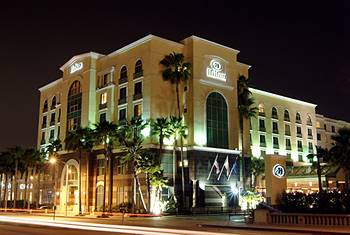
Los Angeles hotels start to market themselves to Chinese tourists

The Hilton Hotels & Resorts and Starwood Hotels & Resorts Worldwide have decided to market their venues to Chinese travelers with the comfort of home.
Both hotels plan to have on staff one Chinese–speaking employee, a tea kettle and slippers in each room, and traditional Chinese breakfast items such as congee known as rice pudding.
And don’t forget the chopsticks!
This new plan was unveiled this week by both hotel chains in hopes to appear to Chinese visitors in the U.S..
Chinese mainland visitors has more than tripled since 2000 and is expected to triple again by 2015.
The Hilton Los Angeles/San Gabriel has already been catering to Chinese visitors earlier this year for three months and the program will continue since approximately 30 – 40 percent of hotel guests are Chinese.
“This will definitely draw more tourists from China,” said Tan Yejun, a businessman from Shandong who was at the Hilton hotel in San Gabriel this week to consider investment opportunities in Southern California. He said the most difficult part about visiting the U.S. is finding locals who speak Chinese, requoted from a Los Angeles Times article.
To make Chinese visitors feel welcome, Hilton Hotels will offer welcome letters in Chinese and television sets will include Chinese language channels. Starwood Hotels will translate a packet of local area information for shopping and sightseeing into Chinese for visitors.
Chinese travelers are the fastest–growing foreign group to visit the U.S. and they also the biggest spenders.

According to Paul Martin, Editor in Chief of  The New Chinese Tourist, a specialized publication about marketing to affluent Chinese outbound tourists, ” Marketing to Chinese tourists is not that easy. Just adding kettles and Chinese tea in rooms of Chinese guests is not enough. US hotels chains like Hilton must learn how to deeply understand how Chinese guests think, what they really like, apart from “clichés” about Chinese tea. They still have a lot to do, in particular with a smarter strategy on Chinese social media to appeal to Chinese visitors when they are planning their trip to the US”
According to the U.S. Commerce Department, Chinese visitors spent an average of $6,243 per person per visit including airfare last year.
Chester Chong, president of the Chinese Chamber of Commerce of Los Angeles called the hotel’s plans “very, very smart” regarding interpreters at the hotels because Chinese businessman visit the U.S. nervous regarding the language barrier.
“It makes me feel more comfortable that the employees and even the waitress speaks Chinese,” said Ji Wei Ping, a visitor from Shanghai who was speaking through a hotel interpreter.
Starwood Hotels operate 1,051 hotels worldwide and 75 hotels in China because it has become the fastest–growing hotel market. The company has approximately 100 more under construction and will open a new hotel every two weeks in China.
Hilton Hotels will be debuting the program at 43 of the Hilton brand’s 540 hotels and at four other affiliated hotels starting August 16. The hotels will include the Hilton Los Angeles and the Hilton Anaheim.
Since the Hilton Los Angeles/San Gabriel was launched, hotel’s general manager Carl Bolte said the food, slippers and other extras have won favorable reviews from Chinese guests.
Los Angeles is the second most popular travel stop in the U.S. for Chinese visitors. New York is the number one tourist destination for Chinese tourists.

1 Comment

Filed under California

Will Chinese tourists save the American economy?

With easing travel restrictions and growing spending power, American politicians and businesspeople look to the increasing number of Chinese travelers to speed economic recovery.
Amid the commotion of shuffling lines and muffled voices, Tina Tian sits in disbelief outside the U.S. Embassy in Beijing. Her head hung low, Tian’s phone rings. She answers her father’s call with a sigh of resignation.   

Five years later, Tian still remembers the disappointment of being denied an entry visa to visit the United States.
“I want to visit America because it is a superpower,” Tian says, now a recent college graduate from Sichuan University. Despite being denied a visa twice, Tian remains determined. “I am a big Lakers fan, I watch Gossip Girls and love to drink Starbucks. My daily life is very influenced by the United States and that is why I want to visit.”
Though Tian has yet to make the trip, Chinese travelers are landing at U.S. airports in record numbers. In 2011, over one million travelers from the Mainland arrived in the U.S., with hundreds of thousands more pouring in from Taiwan and Hong Kong. With expanding incomes and an eagerness to venture abroad, American politicians and businesses are lining up to greet Chinese tourists at the gates.
Speaking at Disney World in February, President Obama announced his vision to expand international tourism as a means to economic recovery.

“Every year, tens of millions of tourists from all over the world come and visit America,” Obama said. “And the more folks who visit America, the more Americans we get back to work.” With the Department of Commerce estimating that Chinese and Brazilian travelers spend an average of $6,000 per visit, ensuring the U.S. is a top travel destination is more national priority than marketing material.
For Tian, that means the third time may be a charm. Obama’s plan included several steps for increasing access to the U.S., including simplifying and accelerating non-immigrant visa processes, making the Global Entry Program permanent and nominating Taiwan to the Visa Waiver Program. The bottom line for the President’s push?
“We need to help businesses all across the country grow and create jobs; compete and win.”
The U.S. Department of Commerce estimates that arrivals from China will increase by approximately 274% between 2012 and 2016. Last year, arrivals from China were estimated at 1,098,000 and 294,000 from Taiwan. If Taiwan is accepted into the visa waiver program, numbers are expected to rise even more as citizens would be eligible to travel to U.S. territories for 90 days without a visa.
With that number expected to top 3 million visitors from China by 2016, American businesses are preparing for their arrival in a big way.
“The number one reason Chinese tourists come to the U.S. is for shopping,” says Pierre Gervois, President and CEO of China Elite Focus, an agency specializing in wealthy Chinese outbound tourism.
This statement holds true as Chinese travelers spent $7.2 billion abroad on luxury goods, a 29% increase from the $5.6 billion last year just during the weeklong Spring Festival holiday.

Advertisement Tower - Gervois Hotel Rating May 2017 featuring Pierre Gervois“The second reason,” Gervois continues, “is that the U.S. is well known for their movie stars and Hollywood scenes and they want to do a lot of sight seeing.”

Carol Martinez, spokesperson from the Los Angeles Convention and Visitor Authority, concurs as she says that significant focus is put on accommodating outbound Chinese tourists through measures like setting up Chinese boarding services at major attraction sites. Martinez highlights that the California Travel and Tourism Commission opened tourism promotion offices in Shanghai and Beijing.
Another compelling reason: travel to the U.S. can act as a social status marker for Chinese and Taiwanese.
“If you can afford to visit and purchase many goods from the U.S., it makes a statement that you are living a good life,” says Nancy Cheng, a Taiwan native.
In 2003, the U.S. opened the Group Visa Program for Chinese travelers, making it far easier for large tour groups, athletic teams, and entertainment groups to enter the country. The most important trend, however, is that visitors from China are beginning to travel independently. Cheng notes this phenomenon as, “a perfect example of xuan fu, which means to show off your wealth.”
“The second wave of China’s outbound tourism has started, with more self-organized travelers slowing down and spreading further afield,” says Dr. Georg Wolfgang, Director of the China Outbound Tourism Research Institute. “Increasingly travel-savvy and globally connected, below 45 years and green, the new Chinese tourist is arriving in exotic locations and staying for more than just a snapshot.”
These “new” Chinese tourists are setting a new standard for Chinese outbound tourism and are eager to explore forms of non-traditional tourism.
Ecotourism, increasingly popular with Western tourists, is also catching on with Chinese. The emphasis of nature immersion and outdoor adventures in locations such as Hawaii and Alaska is becoming more appealing as some Chinese look to escape from the hardships of modern urban living.
Mike McCartney, president of the Hawaii Tourism Authority (HTA), forecasts that the number of Chinese visitors to Hawaii will increase annually by 20% from 2012 to 2014, with those who visit consisting largely of young affluent individuals. For this reason, outdoors activities such as golfing, boating, yachting and surfing are being promoted and emphasized in their marketing efforts.
“Mass tourists will stay on the beaten track, but new Chinese tourists can be attracted to lesser known places if they are provided with a good reason to go there which translates again into prestige,” Wolfgang says. “Connecting destinations with the history of overseas Chinese living in that area might also be a good starting point.”

The exponential rise in Chinese tourists has also positively affected the EB-5 and the proposed EB-6 Visa programs. Intended to attract foreign investors, the EB-5 visa program provides foreign nationals a way to gain a green card for a minimum of $500,000 investment for a targeted employment area within the U.S. The program has created 31,000 jobs and has attracted over $1.5 billion in investments through mainly private companies since its inception. With a surge of Chinese tourists in the U.S., hopes are that the number of applicants for the EB-5 and EB-6 programs will also increase.

While statistics rise for conventional tourist arrivals, there has been a parallel spike in other “grey” forms of travel.  “Birth tourism,” as it has been labeled, sees wealthy pregnant women travel to birth their babies in foreign countries. Potentially living in the country for months before delivery, babies birthed in the U.S. provide two benefits as seen by these Chinese parents: instant U.S. citizenship and a way around China’s pesky one-child policy.
China has already overtaken Italy, Japan, France and the United Kingdom in terms of international tourist spending. In 2010, the average travel spending per Chinese visitor to the U.S. was at $6,243 followed by India at $6,131 and Brazil at $4,940, while European countries peaked at $3,132. The flood of Chinese outbound tourists offers an obvious potential cash flow. With President Obama acknowledging the need to facilitate travel, the U.S. can anticipate more Chinese tourists in more places across the country.
“The primary motivation to travel to the U.S., besides business and visiting friends and relatives, is to gain prestige and to learn,” Wolfgang notes. “To attract Chinese visitors, these two aspects have to be emphasized, ‘Be the most famous, oldest, greatest in your field and provide a mix of entertainment and education.’”
It should only be a matter of time before Tian is sipping Starbucks at her first Lakers game.

Article by Chia-Ling Melody Yuan

Source: http://chinesetourists.wordpress.com

Leave a comment

Filed under USA

Bloomberg TV: Wealthy Chinese Boom in Orange County, CA

Bloomberg TV’s Cali Carlin reports on China’s growing crop of millionaires eying greener pastures in the United States. Their motives range from escaping the one child policy to wealth security and better food safety standards. However, as Bloomberg TV reporters, the top concern is their children’s education.

Leave a comment

Filed under California

President Obama’s travel initiative will increase the number of affluent Chinese tourists spending money in the U.S

Acknowledging the prominent role of the travel and tourism sector in creating jobs and powering the economy, President Obama announced that he has issued an Executive Order aimed at boosting travel and tourism during an event in Orlando, Fla.

The President announced an initiative focusing on improving travel facilitation by coordinating activity among the Department of Commerce, Department of State, and Department of Homeland Security. To achieve this, the President has directed the Department of Commerce to create a task force to develop a “National Travel & Tourism Strategy.” The task force will coordinate cross-departmental efforts and ensure private sector participation.

To increase international tourism to the United States, President Obama recommends promoting unique U.S. destinations/experiences, reducing wait times for visas in rapid-growth countries such as China and Brazil, and making the U.S. Global Entry program permanent.

In remarks, the President stated, “Every year, tens of millions of tourists from all over the world come and visit America. And the more folks who visit America, the more Americans we get back to work. We need to help businesses all across the country grow and create jobs; compete and win. That’s how we’re going to rebuild an economy where hard work pays off, where responsibility is rewarded, and where anyone can make it if they try.”

“I was honored to stand with the President in Orlando as he announced that travel and tourism will be a national priority,” said AH&LA President/CEO Joe McInerney. “Travel and tourism is among the nation’s largest employers and a top ten industry in 48 states – so this effort will benefit every community. By focusing on these high-growth sectors, the United States is poised to create jobs and strengthen the economy.”

Many of the priorities highlighted by the President today are shared by the AH&LA co-chaired Discover America Partnership (DAP). DAP is a lobbying and grassroots campaign working to advance visa and entry reforms in order to regain the share of the international traveler market the United States held in 2000. By recapturing America’s historic share of international travel, the U.S. could create up to 1.3 million new U.S. jobs by 2020 and produce $859 billion in cumulative additional economic output.

“While working with the Travel and Tourism Advisory Board (TTAB), we reported that tourism is a low-cost/high-reward prospect and one of the few industries showing positive growth,” said Nancy Johnson, AH&LA chair and executive vice president, development, Carlson Hotels, America. “Promoting travel produces a multiplier effect that benefits all industries and TTAB estimates we could add 500,000 new U.S. jobs by 2015 with no cost to tax payers. We commend the President for taking this positive step forward.”

“President Obama’s travel initiative will certainly help the U.S. hospitality industry to acquire more affluent Chinese travelers and create more jobs in luxury retail, golf industry, and shopping centers”, said Pierre Gervois, CEO of China Elite Focus, member of the Manhattan Chamber of Commerce. “In cities like New York City, hotels and retailers are now taking initiatives to attract the wealthy segment of Chinese customers, even before they arrive in the country, when they are still in China, planning their shopping trip to the U.S.”

Promoting travel and tourism remains one of AH&LA’s highest priorities. AH&LA and the Discover America Partnership will continue to work closely with Members of Congress, the Administration, and governmental agencies to highlight the incredible opportunity presented by bringing more international travelers to United States.

Leave a comment

Filed under USA

U.S. Travel Association applauds Congress for U.S. Visa System and traveler facilitation reforms for Chinese tourists

The U.S. Travel industry worked with Congressional appropriators to secure significant victories related to U.S. visa system and traveler facilitation reforms in the Consolidated Appropriations Act of 2012. The legislation reflects 2011 advocacy efforts by the U.S. Travel Association to improve the U.S. economy, remove barriers to travel and improve the travel process.

The U.S. Travel industry worked with Congressional appropriators to secure significant victories related to U.S. visa system and traveler facilitation reforms in the Consolidated Appropriations Act of 2012. The legislation reflects 2011 advocacy efforts by the U.S. Travel Association to improve the U.S. economy, remove barriers to travel and improve the travel process.

“This legislation is an acknowledgment by Congress that reforms to the U.S. visa and entry systems and passenger screening process are key to improving our nation’s economy,” said Roger Dow, president and CEO of the U.S. Travel Association. “Clearly, the travel community is being heard, and we applaud Congress for addressing these issues.”

“The extended visa expiration period for affluent Chinese tourists doing frequent luxury shopping tours to the U.S. is an excellent news for the U.S. luxury retail industry” said Pierre Gervois, an expert in marketing to wealthy Chinese outbound tourists and member of the Manhattan Chamber of Commerce. “That will mean more wealthy Chinese customers spending more money in U.S. luxury shopping malls and flagship stores, and creating more american jobs in the luxury retail industry”

U.S. VISA SYSTEM REFORM – The Act mirrors a number of recommendations put forth by the U.S. Travel Association in a May 2011 report on the U.S. visa system. That report identified visa wait times, visa validity periods and videoconferencing technology as keys to improving a system that cannot meet demand in emerging economies with growing markets of international travelers.

Initiatives championed by U.S. Travel and included in the consular affairs section of the bill include:
Visa Wait Time Reductions – To reduce the number of days applicants must wait before their visa application interview, the bill directs the Secretary of State to hire a sufficient number of consular officers, including limited non-career appointment (LNA) officers, in China, Brazil and India. These LNA officers will give the State Department hiring flexibility to meet increasing visa demand in the coming years.
Better Metrics and Long-Term Planning – Congress directs the Secretary of State to report on the steps it will take to reduce current visa processing wait times but also to submit a 5-year forecast of visa demand in Brazil, China and India. The plan should outline the number of consular officers necessary to meet the Department’s 30 day visa processing standard. Congress also directs the State Department to compare its forecast with the Commerce Department’s visitor projections in order to allow it to produce better long-term plans.
Extended Visa Expiration Period – A plan must be developed by the State Department to extend expiration periods for leisure or business visas that require a consular officer interview. The visa validity period for Chinese citizens is only one year, and U.S. Travel has recommended extending the visa validity period to five or 10 years, common with other countries, so business and leisure travelers do not have to undergo the visa renewal process annually and State can better meet demand of new applicants in China.
Secure Videoconferencing Technology – Congress has cleared the Secretary of State to develop and conduct a pilot program to conduct visa interviews for leisure and business visas using secure remote videoconferencing technology. With limited consular offices in emerging economies such as Brazil, China and India, the addition of remote secure videoconferencing would allow more citizens to apply for U.S. visas.
U.S. ENTRY & EXIT SYSTEM REFORM – The Act includes a number of significant improvements to the entry and exit process at U.S. air and land ports of entry.
Increased Staffing – The bill provides funding to hire an additional 300 new Customs and Border Protection Officers to improve processing of inbound travelers at land border crossings and international U.S. airports.
More Oversight of Operations – The bill requires CBP to report to the Congress on its long-term staffing plans and implementation of key entry reforms such as trusted traveler programs and elimination of unnecessary rescreening of international travelers and baggage.
Air Exit System – The bill provides $9.4 million to the development of a comprehensive plan for enhancements of a biographic air exit program to bolster security and allow for further expansion of the Visa Waiver Program.
DOMESTIC AVIATION FACILITATION REFORM – The Act makes a series of recommendations designed to improve the efficiency of traveler facilitation including:
Congressional Reports on Efficiency – TSA must submit to Congress reports on passenger and baggage screening efficiency and on how its workforce is being deployed at the nation’s airports to maintain average wait times below 10 minutes. As a recent U.S. Travel survey showed, an overwhelming majority of passengers are frustrated with screening checkpoints. The bill also encourages TSA to utilize privatized screening where more cost-effective.
Trusted Traveler – To help implement recommendations akin the U.S. Travel Blue Ribbon Panel on Aviation Security, the bill provides TSA $10M to implement risk-based screening and to expand known-traveler populations beyond the current PreCheck program.

In 2012, the U.S. Travel Association will pursue policies on behalf of the travel industry, many of which will create much-needed U.S. jobs and improve the economy. These include legislative vehicles for additional visa system reform, expanding the Visa Waiver Program, enhancing the entry process at ports of entry, and improving the efficiency of the U.S. air travel system.

Leave a comment

Filed under USA

How to attract more Chinese tourists to the U.S.? Chinese Digital Media or Traditional Travel Agencies?

Inbound travel to the U.S. from China is skyrocketing. Arrivals from China are forecast to increase a whopping 274% between 2012 and 2016. It’s the fastest growth –– by far –– of any country, according to the U.S. Department of Commerce.

“If Chinese people have not visited the U.S., they feel they haven’t really seen the world,” said Haybina Hao, director of international development for NTA.

Most first-time visitors to the U.S. opt for group tours sold by Chinese travel retailers. But independent travel is gaining in popularity, Hao told Travel Market Report, in a recent interview at the NTA Visit USA Center in Shanghai.

According to Pierre Gervois, from China Elite Focus, a Shanghai based agency providing marketing services to international travel agencies willing to attract more Chinese tourists, “The fastest growing segment of Chinese travelers is the category of affluent travelers, from the upper-middle class. They tend to rely more on on-line travel agencies, and don’t really trust traditional Chinese travel agencies to advise them on their trip.” “The best way of catching the interest of these new Chinese travelers is a presence on key Chinese social media, and to have the destination endorsed by influent Chinese Travel Bloggers”, Gervois added.

Hao, who works out of the NTA’s Lexington, Ky., office, was in China to participate in a series of road shows for travel agents and consumers.

Return visitors are adventuresome
The typical first-time traveler spends an average of two weeks in the U.S., according to Hao. Their standard itinerary includes some combination of New York City, Las Vegas, Los Angeles and San Francisco.

Repeat visitors are decidedly more adventurous, often focusing on activities such as golfing, skiing and driving, Hao said.

Some repeat visitors are giving new meaning to the concept of fly-drive packages.

Earlier this year, groups of Chinese visitors traveled to York, Penn., for a tour of Harley-Davidson’s motorcycle factory, then saddled up a fleet of hogs and rode to Philadelphia as part of a group itinerary, Hao said.

Affluent visitors take to the skies
Another trend among repeat visitors includes tours that are organized around flying private planes.

According to Pierre Gervois, from China Elite Focus,

Hao explained that while consumers can earn a pilot’s license in China, airspace restrictions and a lack of facilities make it all but impossible to actually spend time in the air behind the controls.

Hao has seen an increase in affluent Chinese visitors who travel to the U.S. to put their pilot licenses to use.

Agent education in second-tier cities
While these metropolitan areas have populations that approach 10 million, most travelers prefer to work with travel agencies in Shanghai and Beijing because the second-tier cities often lack sufficient travel agency services, she said.

It is the goal of the Visit USA Center to change that.

The Visit USA Center staff recently completed a round of presentations for consumers and agents in second-tier cities such as Chongqing, Chengdu, Shenyang and Dalian, Hao said.

The events were held in conjunction with U.S. suppliers, including Disneyland Park, tourism representatives from the state of Georgia, Hilton Hotels, and five West Coast-based tour operators that specialize in in-bound Chinese travel.

Building leisure travel
The mission of the Visit USA Center, which opened in Shanghai in January, is to foster leisure travel from China to the U.S.

Key strategies included facilitating relationships between travel professionals in both countries and marketing the U.S. as a tourism destination to Chinese consumers. The Visit USA Center also maintains a website in traditional Chinese, simplified Chinese and English.

Warnings on cut-rate trips
A recent focus of the Visit USA Center is helping travelers understand that cut-rate itineraries often do not provide the best travel value and experience.

“Chinese people are very careful with their money, and they negotiate hard with travel agencies for lower-price options,” she said. In the past, retailers have promoted tours that offer low-cost per diem rates, but hit travelers with expensive add-ons once they are in the U.S.

“Don’t forget that the old image of the Chinese customer always bargaining for a low price is vastly a stereotype” said Gervois. “The new generation of affluent Chinese travelers want high quality travel services and are perfectly ready to pay for them”, he added.

2 Comments

Filed under New York

Hawaii Governor working to attract more Chinese tourists

Reaching out to China’s booming tourism market will be a priority for Hawaii Governor Neil Abercrombie during the three-day China-US Governors Forum in Beijing.

Hawaii Tourism Authority (HTA) President Mike McCartney and other tourism officials will join Abercrombie – on his inaugural trip to Asia – at the forum on Oct. 19, 2011.

A good relationship between China and the United States will not only stimulate Hawaii’s economy but also promote cultural understanding, Abercrombie said.

Hawaii already has sister-state relationships with Guangdong and Hainan provinces.

“Chinese culture and traditions have long since become intertwined into our own local culture, building on Hawaii’s longstanding and very special relationship with China,” Abercrombie said.

Guam Governor Eddie Baza Calvo, who will also attend the forum, is also interested in promoting the US territory as a travel destination for Chinese people.

At the US-China Governors Forum in Salt Lake City in February, he discussed with Zhejiang Party Secretary Zhao Hongzhu the potential for increased tourism from China if a visa waiver program is approved.

“US governors and the (Barack) Obama administration understand how critical it is for the nation to build economic alliances with China,” Calvo said.

Zhao told Calvo he intends to encourage residents of his populous province to visit Guam, according to Calvo. Zhao mentioned that many Zhejiang residents currently vacation in Singapore, which is a six-hour flight, whereas the flight to Guam is only four hours.

The number of Chinese tourists in Hawaii has jumped significantly since the signing of the 2007 Memorandum of Understanding between the US and China to allow Chinese vacationers to visit the country.

HTA, Hawaii’s state tourism agency, projects a total of 91,000 Chinese visitors to Hawaii this year, a 37 percent increase over last year.

The average Chinese tourist spends $349 per person each day, according to data compiled by HTA, whereas Japanese visitors spend an average of $261 each day.

Hawaii’s Department of Business, Economic Development & Tourism forecasts the number of Chinese visitors to Hawaii will increase annually by 20 percent from 2012 to 2014. By 2014, Hawaii will have 140,000 Chinese visitors a year.

At the upcoming three-day forum, McCartney will join Abercrombie for a meeting with Shao Qiwei, director of China’s National Tourism Administration.

The two will also meet officials from China Eastern Airlines and the US embassy, as well as representatives from the airline and travel industries.

HTA works closely with its overseas contractor Hawaii Tourism China, which has offices in Shanghai and Beijing, to promote Hawaii to Chinese travelers as a vacation and business destination, according to McCartney.

In August, China Eastern Airlines launched its first direct, nonstop flight between Shanghai and Honolulu, the first twice-a-week flight connecting China and Hawaii.

HTA estimates that this regularly scheduled flight, on Tuesdays and Fridays, will provide the state with $60 million in annual visitor expenditures.

Before traveling to the US, Chinese travelers are required to obtain a tourist visa. When the Visa Waiver Program was introduced for tourists from South Korea in 2008, the number of travelers from South Korea to Hawaii increased significantly, according to McCartney.

McCartney said the state has been working hard to support efforts that could help expedite the process for obtaining travel visas.

“We understand the visa process for Chinese visitors is long, and we hope to ease it,” McCartney said.

Leave a comment

Filed under Hawaii