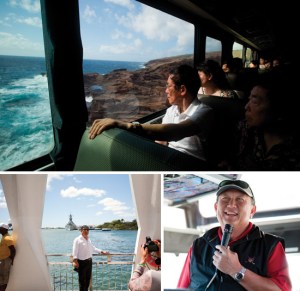
 Somewhere between Chen’s Gourmet Buffet and the statue of King Kamehameha, Wayne Lu lost half his audience.
Lu is a tour guide for a Honolulu travel company called Dragon Tours & Travel, and his audience is a group of 30 vacationers from mainland China on the first day of a whirlwind, 12-day, eight-city tour of the United States.
Somewhere between Chen’s Gourmet Buffet and the statue of King Kamehameha, Wayne Lu lost half his audience.
Lu is a tour guide for a Honolulu travel company called Dragon Tours & Travel, and his audience is a group of 30 vacationers from mainland China on the first day of a whirlwind, 12-day, eight-city tour of the United States.
He met them in the morning at the airport, whisked them off to see the Arizona Memorial, then brought them to lunch at Chen’s, an all-you-can-eat Chinese buffet along Nimitz Highway. There, he made a prediction: “Fifty percent will fall asleep after lunch.”
After a 15-hour trip to Honolulu from Shanghai, via Tokyo, the group was beat. By the time its motor coach stopped across from Iolani Palace, beside the Kamehameha statue, Lu’s prediction had come true. Despite his amiable, nonstop patter, at least half the bus had nodded off.
“They always fall asleep after lunch,” Lu said again, after his bleary-eyed charges descended from the motor coach to take photos beneath Kamehameha’s outstretched arm.
Meet the weary pioneers of Chinese leisure travel, forerunners of a rapidly building new wave of wealthy and middle-class visitors from the People’s Republic of China. Increasingly, you can find them piling out of buses at the usual tourist attractions, or forking out huge sums for designer handbags and watches at luxury shops in Ala Moana and Waikiki, or learning the hard way that haggling at the Apple Store will get you nowhere.
Although they make up a tiny fraction of the 7.2 million visitors overall that Hawaii saw last year, their numbers are growing quickly—from 28,664 in 2001 to 79,531 in 2011. Just as China’s economy surpassed Japan’s as the world’s second-largest in 2010, so, too, could the number of Chinese tourists in Hawaii someday surpass the number of Japanese tourists.
“One day, in my opinion, it will happen,” says Sadie Goo, China market brand manager for the Hawaii Tourism Authority. “Given that China’s population is 1.4 billion, and they have so many wealthy people and so much disposable income, they will eventually be the No. 1 outbound source market in the world.”
To make the acquaintance of these fledgling travelers with the potential to transform the face of Hawaii’s visitor industry, HONOLULU Magazine shadowed Lu and his 30 travelers on their two-day tour of Oahu.
Fewer than 15 percent of Hawaii’s Chinese tourists come to Hawaii as independent travelers, booking their own trips, following their own schedules, renting cars and confounding local drivers unfamiliar with China’s first-is-right rule of the road. The majority of Chinese tourists in Hawaii today come with group tours, often part of steeply discounted, multi-city packages that jam as much Hawaii into as little time as possible.
Such was the case for Lu’s people, who Dragon Tours, agent for the Hawaii leg of their trip, would host for their two days on Oahu. After that they were off to Los Angeles, San Diego, Las Vegas, Buffalo (with a side trip to Toronto, for those with Canadian visas), New York, Washington, D.C., and, finally, San Francisco. Honolulu was just the first dot on the map.
Escorting them from Shanghai across America and back was the trip leader, Zeng Wei Ji, a boyish 45-year-old who introduces himself to Westerners as “Ricky.” Ricky studied to be an industrial engineer, but, 20 years ago, he got an opportunity with a Hong Kong-based travel company to lead a tour to the United States. He’s been an international trip leader ever since. Originally, his company catered to groups from Hong Kong and Macau, but, in the last few years, it’s expanded to mainland China. Now that’s where almost all his tour groups come from.
The competition among travel agencies for these outbound Chinese travelers is highly competitive. If one company offers an all-inclusive, nine-city, 12-day trip across America for the ultra-rock-bottom low price of, say, $2,000 (as Ricky’s company does), another company will offer the same thing for $1,950. Then another will come along and offer the same deal for $1,900. “It’s a hard business,” Ricky explained. “Everybody undercuts everybody.”
For China’s fledgling world travelers, the smart choice is widely regarded as the package that offers the greatest number of foreign cities for the least amount of money. “They think that is the best deal,” Ricky said. “But they will spend most of their time sitting on buses.”
Tourists from mainland China are not hard to spot, at least to Lu’s seasoned tour-guide eyes. “They don’t dress like the Japanese or the Koreans,” Lu said while waiting at the airport that morning for his group to emerge from customs. Even their suitcases look different, he said: “Their luggage is always more beat up. It looks like it’s had lots of rough handling.”
In contrast to the fashionably dressed mass of Japanese tourists outside the airport’s international terminal, Wu’s 30 travelers, once he’s rounded them up, looked perfectly unassuming in their simple plaids and stripes, denim jeans, starter jackets and sequined sweaters. A few wore bulging fanny packs, and all appeared to wear off-brand, no-nonsense shoes. One otherwise matronly woman wore a T-shirt adorned with a bejeweled heart and the words “Good Love First Time.”
China’s growing ranks of millionaires and billionaires aren’t the ones blasting through Hawaii on tours like these. Among Lu’s group there was an accountant, several retirees and a cagey man who claimed to be a bus driver, then said he was a clerk, but, frankly, had the air of a low-ranking Communist Party official. There were also two young women who worked for different travel agencies. They were each traveling alone, on vacation, and had just met, but were clearly destined to be great friends. To keep accommodation costs down, Ricky had paired them as roommates for the duration.
For decades, the Chinese could travel to the United States only on business, as students or to visit family. The door opened to tourism for the sake of tourism in 2008, after the U.S. pledged to speed up the glacial pace of its visa processing, and China, in turn, granted the U.S. “approved destination status,” allowing Chinese visitors to come here for no better reason than to sightsee and shop. From 2008 to 2011 the number of Chinese visiting Hawaii climbed by more than 25,000.
Last August, China Eastern Airlines launched the first direct, regular air service from China to Hawaii, with 287-passenger flights arriving from Shanghai every Tuesday and Thursday. These are expected to push Chinese visitor numbers for 2012 above the 100,000 mark.
While the Japanese are still way out ahead, with 1.3 million travelers expected this year, the Chinese stats come with a footnote that has the visitor industry abuzz: the Chinese spend more. Way more. Last year that amounted to $382 per person per day—nearly $100 more than the Japanese, who have have traditionally been Hawaii’s biggest spenders.
Much of this spending is on luxury goods at high-end shops like Chanel, Tiffany & Co. and Gucci, brands which are available in China, but always with heavy tariffs and the spectre of the counterfeiter. “You can buy what looks like a Gucci bag in China,” says Frank Haas, dean of the hospitality, business and legal-education program at Kapiolani Community College, “and never really be sure it’s authentic.”
Hawaii’s tourism machine has been gearing up for this lucrative new market for some time now.
Delegations of high-ranking state officials frequently trek to China to promote tourism and trade. The Hawaii Tourism Authority has opened offices in Beijing and Shanghai, and launched a Chinese-language version of its website. The Bank of Hawaii has made arrangements with China’s largest issuer of bank cards, permitting electronic transactions with thousands of merchants throughout the Islands. Shops from Luxury Row in Waikiki to the factory outlets in Waikele have been staffing up with sales people fluent in Mandarin.
Nobody, however, has rolled out the red carpet quite like Starwood Hotels & Resorts, whose Hawaii hotels include The Royal Hawaiian, the Moana Surfrider and the Sheraton Waikiki. Mandarin speakers greet Chinese visitors at the front desk when they check in and check out, and are on hand around the clock to troubleshoot. There are amenities in the rooms to which the Chinese are accustomed, such as tea pots, green tea, slippers and fresh toothbrushes. There’s Chinese programming on the TVs and Mandarin translations of most hotel literature, including menus, which feature dumplings and congee (rice porridge) for breakfast. There’s a general awareness of Chinese cultural indiosyncracies, such as the association of the number four with death. A Canadian traveler probably wouldn’t think twice about Room 444, but a Chinese traveler might sleep better elsewhere.
Using the curriculum Starwood developed, more than 2,000 hospitality workers throughout the visitor industry have gone through crash courses in Chinese cultural fundamentals at Kapiolani Community College, learning that “nihao” means hello and that one should not be taken aback if the Chinese, not the world’s greatest huggers, seem a little stiff during the Hawaiian lei greeting.
While Hawaii is figuring out how to make the Chinese feel at home, the Chinese are figuring out how to travel abroad gracefully.
There are some high cross-cultural hurdles to clear. Take tipping, for instance, which isn’t something they are accustomed to doing, or haggling, which isn’t something they are accustomed to suppressing. “Bargaining and haggling are the Chinese tradition,” says Ted Sturdivant, president of the Hawaii Chinese Tour Association and publisher of a guidebook to Hawaii for the Chinese. “In fact, it’s fun for them.” Tour companies don’t typically warn Chinese visitors that U.S. retail prices aren’t negotiable, according to one visitor-industry insider, because they don’t want to deflate their morale.
Then there’s the delicate matter of bad manners. Complaints about the bad behavior of early waves of Chinese leisure travelers abroad so alarmed the state-run China Daily that it declared the culprits had “damaged the image of China as a civilized country.” The China National Tourism Administration, along with the Office of Spiritual Civilization Development Steering Commission, followed up with a list of dos and don’ts for international travelers, including: don’t spit, don’t litter, don’t talk loudly, don’t cut in line and do observe the “ladies first” rule.
Lu’s group wasn’t ill-behaved, so perhaps the outbound Chinese are absorbing the government’s etiquette tips. Or maybe everybody was just too tired to get into any trouble. In any case, after 12 minutes at Kamehameha’s statue, the group got back on the motor coach and headed for The Waikiki Sand Villa, an aging budget hotel located across the street from the Ala Wai Canal. It is not a Starwood property. There are no Mandarin speakers at the front desk, and breakfast consists of toast, juice and coffee. But the signs warning pedestrians to stay off the automobile ramp have been translated into Mandarin.
Ricky handled the check-in and Lu announced he would meet everybody back in the lobby in three hours so they could walk together to the Chinese buffet at Hokele Restaurant for dinner. He would also show them how to get to the DFS Galleria, where foreign travelers can shop duty free.
It was important that everyone could find their way back to the duty-free shops after dinner. There’s no profit margin for Dragon Tours in selling cut-rate packages like these, which are known in the industry as “zero-dollar tours.” Instead, the money is in the commissions Dragon gets for selling add-ons, like submarine rides and sunset cruises, and for bringing business to restaurants and retailers, like the shops at DFS Galleria.
Lu’s group was on the move again the next morning, seeing Waikiki Beach, the Diamond Head lookout, and luxurious Kahala homes through the motor coach’s darkly tinted windows. A few brand-new iPads, purchased the night before, came out to record the sights. After a 20-minute stop at Haunauma Bay, and another 20-minute stop at the Blow Hole, the motor coach barreled back into town and rolled to a stop on unglamorous Young Street, in front of a jewelry store called Keoni.
During the drive, Lu put in a few good words for black coral, red coral and black pearls, all of which are prominently featured in the Keoni collection. The group dutifully filed into the display room, where elegant young women stood behind glass counters, ready to deal. Johnnie Fong, Keoni’s owner, greeted Lu warmly and slipped him a crisp $20 bill for his trouble, then slipped the bus driver a $10.
Fong said he moved Keoni from Waikiki to Young Street specifically to accommodate bus tours like these. While this particular group didn’t show much interest in his jewelry, “it just takes one good customer,” as Fong put it, to make the whole thing worthwhile. When the group boarded the motor coach, 20 minutes later, only one piece of the Keoni collection went with it, a relatively inexpensive olivine stone.
As the motor coach headed back for Waikiki, Lu put in some good words for the healthful benefits of Hawaiian noni and an antioxidant product from the Big Island called BioAstin. Both of these could be found at the group’s next stop, AMW Wholesale, a vitamin and souvenir shop hidden away on the second floor of the Waikiki Trade Center. Lu’s shoppers were far more enthusiastic about this place than the jewelry store, and as they followed him to their next stop, lunch at China Garden Restaurant, they carried bags full of mac nuts, Hawaiian chocolate, BioAstin and noni in its capsule, tablet, soap, gel and body lotion forms.
After lunch Lu, turned the group loose in Waikiki for more shopping. He returned later that afternoon to take the 16 who had signed up for the sunset cruise to Pier 8, where they would board the Star of Honolulu. “Sixteen’s pretty good,” he said. “Not great, but pretty good.” The next morning, he would pick everyone up at 4 a.m. and take them back to the airport for their early morning flight to LAX and the beginning of the rest of their grand American tour.
“They will spend a lot of time on the bus,” Ricky said before taking back the reigns of the tour from Lu. “When they get home, they will show their family and their friends the pictures, and they can tell everybody that they have seen the United States.”
Source: http://www.honolulumagazine.com

 The U.S. is also a very popular luxury travel destination for affluent Chinese tourists, who distinguished great luxury shopping experiences (South Coast Plaza, Best USA Luxury Shopping Mall), historical hotels (Waldorf-Astoria, Best USA hotel), luxury lifestyle exeriences (Crowds on Demand, World’s Best Luxury Lifestyle Experience), or travel agencies (Luxe Travel Hawaii, Best USA Luxury Travel Agency), to quote a few.


 southerners.
Major chains are also training employees to avoid cultural missteps that would offend a Chinese visitor. Superstition is a big one: Red is considered a lucky colour, along with the number eight, which signifies wealth. The colour white, meanwhile, is frowned upon.
Failing to respect the pecking order in a Chinese group is another common blunder.
“We try to make sure nobody’s on a higher floor than their boss,” Armstrong said. “Even if the boss is on a beautiful suite on the eighth floor, if the assistant is in a standard room on the 38th floor, it doesn’t translate.”
The race is also on to build loyalty within China’s borders. Last year, Starwood Hotels, which has a Chinese “specialist” at each American hotel, relocated its senior leadership team to China for a month. The Ritz-Carlton rotates general managers and other hotel staff into its Chinese hotels for three-year stints at a time. And both chains are banking on the success of their customer rewards programs, which have been a big hit in China.
“It’s important for our leaders to understand what’s going on there at a more personal level than just the statistics,” said Clayton Ruebensaal, vice president of marketing for the Ritz. “Everybody’s going after this market because of the sheer volume of luxury customers. At the same time, it’s a very crowded landscape.
southerners.
Major chains are also training employees to avoid cultural missteps that would offend a Chinese visitor. Superstition is a big one: Red is considered a lucky colour, along with the number eight, which signifies wealth. The colour white, meanwhile, is frowned upon.
Failing to respect the pecking order in a Chinese group is another common blunder.
“We try to make sure nobody’s on a higher floor than their boss,” Armstrong said. “Even if the boss is on a beautiful suite on the eighth floor, if the assistant is in a standard room on the 38th floor, it doesn’t translate.”
The race is also on to build loyalty within China’s borders. Last year, Starwood Hotels, which has a Chinese “specialist” at each American hotel, relocated its senior leadership team to China for a month. The Ritz-Carlton rotates general managers and other hotel staff into its Chinese hotels for three-year stints at a time. And both chains are banking on the success of their customer rewards programs, which have been a big hit in China.
“It’s important for our leaders to understand what’s going on there at a more personal level than just the statistics,” said Clayton Ruebensaal, vice president of marketing for the Ritz. “Everybody’s going after this market because of the sheer volume of luxury customers. At the same time, it’s a very crowded landscape.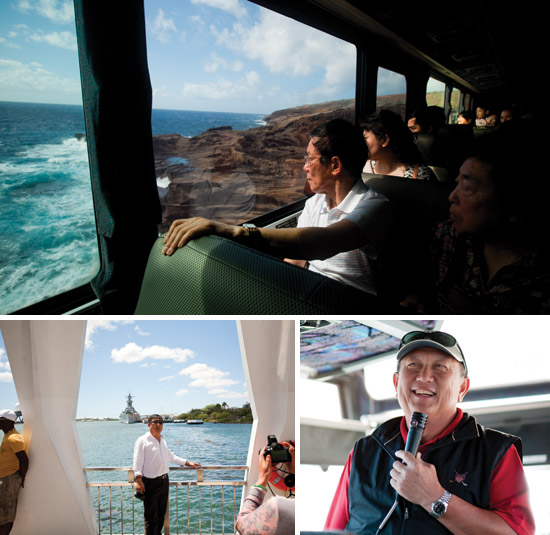







 Chinese tourists in America